
The dewatering of excavations in aquifers within sheet pile walls requires a very precise technical approach: it's not enough to lower the water level, but also necessary to manage the hydraulic pressures acting on the wall and maintain stable conditions throughout the construction site duration. In a project at a power plant, Aquageo supported the implementation of a wellpoint system designed to work both inside and outside the wall, aiming to increase safety and operational reliability.
Application Context
-
Excavation of approximately 12 m x 14 m.
-
Wall with Larssen sheet piles 12 m deep.
-
Installation of two prefabricated tanks inside the excavation.
-
Static water table level at about -1.8 m from the ground level.
The challenge: lower the water table and reduce hydraulic pressure on the wall
The client's objective was twofold:
-
lower the water table by about 3 m inside the wall, to ensure dry and stable conditions in the excavation;
-
reduce the hydraulic pressure on the outside of the sheet piles, avoiding bending and structural issues during operations.
The complexity increased due to the variability of the soils, characterized by sandy silts with gravel fractions in a fine matrix, thus with not completely uniform hydraulic behavior.
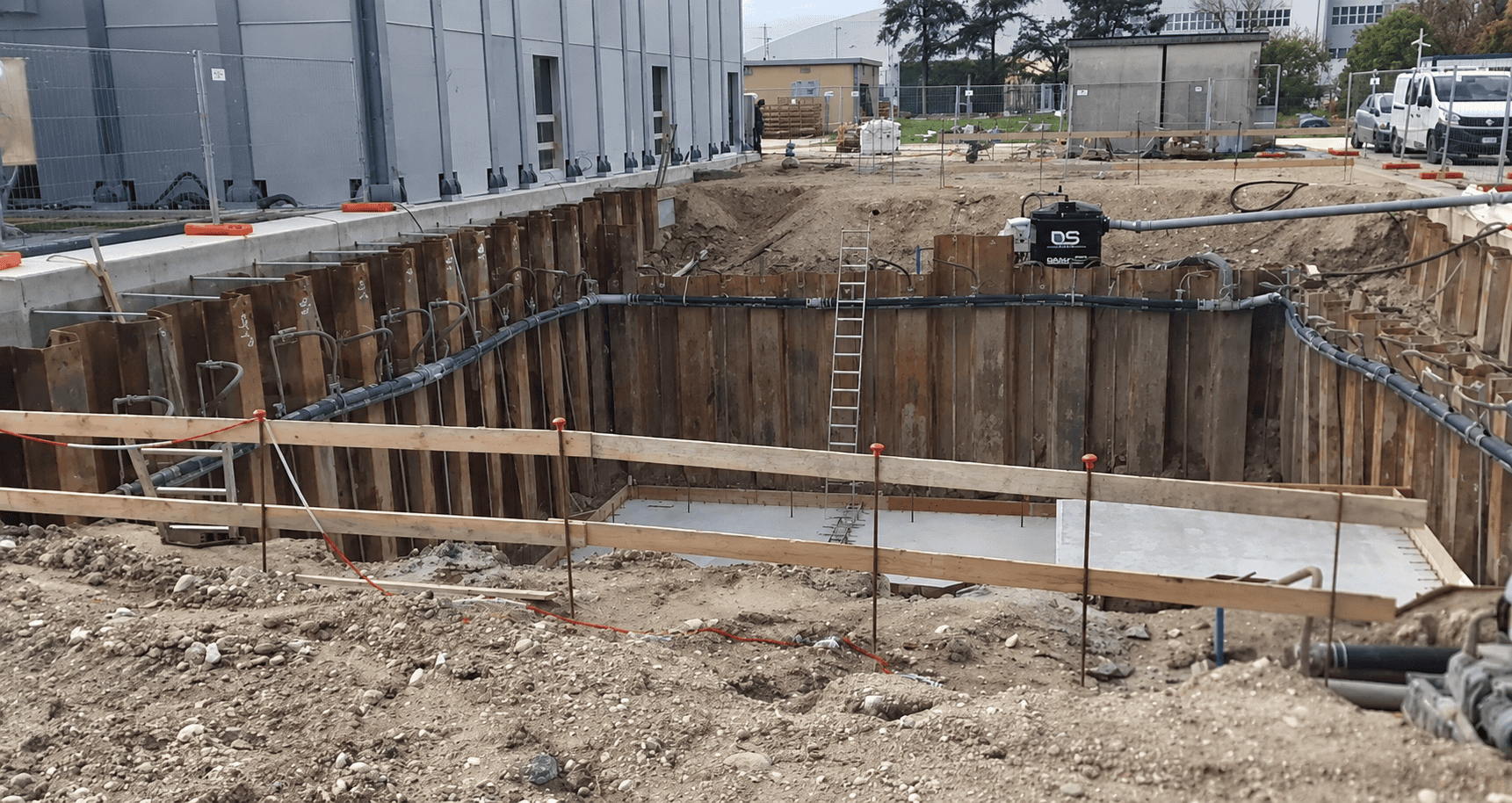
Aquageo Solution: dual wellpoint system with vertical drains and low-energy pumps
To achieve more effective control of the hydraulic regime, Aquageo adopted two independent wellpoint systems:
-
a system inside the wall (for lowering the water table in the excavation);
-
a system outside the wall (to relieve the hydraulic pressure from the outside).
Installation with vertical drain technique
The implementation included:
-
drilling with holes of about Ø 200 mm, performed with an auger on an excavator;
-
installation of about 60 wellpoints of 5 m;
-
placement of washed and screened sand 0–5 mm as filter material to create stable drains and protect the filters from clogging risk due to the fine fraction (silt).
Performance and pumping
-
Total system flow rate: about 1,200 l/min, maintained constant even with lateral soil heterogeneity.
-
The system was completed with Dragflow TP100 drainage pumps, selected for their low energy consumption and operational continuity.
Result: safe excavation and adherence to project timelines
The dual wellpoint configuration allowed:
-
maintaining the water table level within the required parameters;
-
reducing hydraulic stresses on the wall;
-
ensuring stability to the excavation and continuity to the installation activities of prefabricated structures.
Benefits for the client
The intervention with the internal/external wellpoint system brought tangible advantages:
-
greater excavation stability in the presence of water table and fine soils;
-
reduction of the risk of sheet pile bending, thanks to the control of hydraulic pressures;
-
more accurate drainage control, with two independent circuits;
-
stable and predictable flow rate (about 1,200 l/min);
-
energy efficiency and operational continuity with dedicated pumps.